SUBSCRIBE TO OUR FREE NEWSLETTER
Daily news & progressive opinion—funded by the people, not the corporations—delivered straight to your inbox.
5
#000000
#FFFFFF
To donate by check, phone, or other method, see our More Ways to Give page.
Daily news & progressive opinion—funded by the people, not the corporations—delivered straight to your inbox.
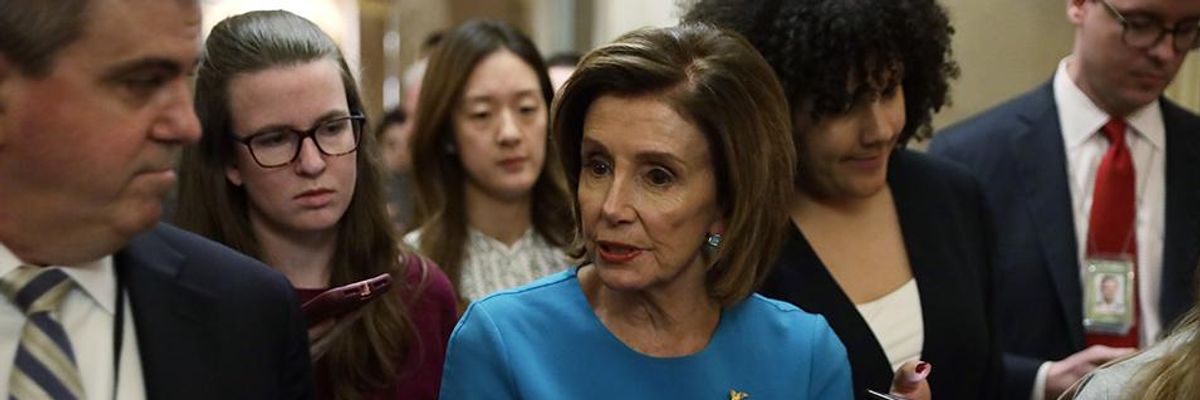
U.S. Speaker of the House Rep. Nancy Pelosi (D-CA) is followed by members of the media on her way back to her office after a briefing at the U.S. Capitol March 13, 2020 in Washington, DC. Speaker Pelosi held a briefing on the Coronavirus Aid Package Bill that will deal with the outbreak of COVID-19. (Photo by Alex Wong/Getty Images)
Early Saturday morning the US House of Representatives voted 363-40 to pass a coronavirus relief package, days after the World Health Organization declared the virus a pandemic. The US Senate won't take the bill up until at least Monday, because Senate Majority Leader Mitch McConnell decided to give Senators the weekend off.
House Speaker Nancy Pelosi is facing widespread criticism Saturday for misrepresenting what the legislation would actually do.
In a letter to her Democratic colleagues Saturday Pelosi wrote:
"I am very proud to write that the provisions we put forth with your input, including paid sick leave, paid family and medical leave, enhanced Unemployment Insurance, food security initiatives and free and widespread testing, are all included in this agreement. "
The New York Times editorialized Saturday afternoon:
House Speaker Nancy Pelosi early Saturday celebrated passage of legislation she described as providing paid sick leave to American workers affected by the coronavirus.
She neglected to mention the fine print.
In fact, the bill guarantees sick leave only to about 20 percent of workers. Big employers like McDonald's and Amazon are not required to provide any paid sick leave, while companies with fewer than 50 employees can seek hardship exemptions from the Trump administration.
"If you are sick, stay home," Vice President Mike Pence said at a news conference on Saturday afternoon. "You're not going to miss a paycheck."
But that's simply not true. Sick workers should stay home, but there is no guarantee in the emergency legislation that most of them will get paid.
The White House and congressional Republicans, who insisted on the exemptions as the price of bipartisan support for the legislation, bear the primary responsibility for the indefensible decision to prioritize corporate profits in the midst of a public health emergency...
The House's failure to require universal paid sick leave is an embarrassment that endangers the health of workers, consumers and the broader American public.
This country and this world are at a monumental crossroads. US voters have an opportunity to beat back the forces of fascism and confront the billionaires who are rigging the economy, our media system, and our democracy, making it increasingly impossible for ordinary people to get by. We’re not just talking about the election. We’re talking about what must be done once these fascist elements are vanquished from power. We need a bolder set of solutions than what either major party has so far been willing to offer and a working-class movement ready to fight like hell for it. Trump didn't emerge from nowhere. The conditions that fueled MAGA authoritarianism were created by decades of radical neoliberal economic policies and a corrupt political system dominated by corporate interests. They slashed taxes on the super-rich, promising that the benefits would trickle down. They said giveaways to the corporate titans would make life more affordable for the rest of us. It was all bullshit. And when a bitter, betrayed populace searches for someone to blame, right-wing demagogues have little trouble finding scapegoats. People know when they're being lied to, but you won't hear any of this from the corporate media. Only independent journalism—powered and funded by people who believe in building a better world—can deliver truly trustworthy daily news. If you share our vision, please contribute whatever you can to sustain our work. |
Early Saturday morning the US House of Representatives voted 363-40 to pass a coronavirus relief package, days after the World Health Organization declared the virus a pandemic. The US Senate won't take the bill up until at least Monday, because Senate Majority Leader Mitch McConnell decided to give Senators the weekend off.
House Speaker Nancy Pelosi is facing widespread criticism Saturday for misrepresenting what the legislation would actually do.
In a letter to her Democratic colleagues Saturday Pelosi wrote:
"I am very proud to write that the provisions we put forth with your input, including paid sick leave, paid family and medical leave, enhanced Unemployment Insurance, food security initiatives and free and widespread testing, are all included in this agreement. "
The New York Times editorialized Saturday afternoon:
House Speaker Nancy Pelosi early Saturday celebrated passage of legislation she described as providing paid sick leave to American workers affected by the coronavirus.
She neglected to mention the fine print.
In fact, the bill guarantees sick leave only to about 20 percent of workers. Big employers like McDonald's and Amazon are not required to provide any paid sick leave, while companies with fewer than 50 employees can seek hardship exemptions from the Trump administration.
"If you are sick, stay home," Vice President Mike Pence said at a news conference on Saturday afternoon. "You're not going to miss a paycheck."
But that's simply not true. Sick workers should stay home, but there is no guarantee in the emergency legislation that most of them will get paid.
The White House and congressional Republicans, who insisted on the exemptions as the price of bipartisan support for the legislation, bear the primary responsibility for the indefensible decision to prioritize corporate profits in the midst of a public health emergency...
The House's failure to require universal paid sick leave is an embarrassment that endangers the health of workers, consumers and the broader American public.